

Reliable Waterways: Groundbreaking Ceremony for the New Erlangen Lock
- Replacement of the existing lock will secure the long-term operational performance of the Main-Danube Canal
- Joint venture between ZÜBLIN and BAUER Spezialtiefbau to deliver this major infrastructure project
- Construction work will be carried out while navigation continues
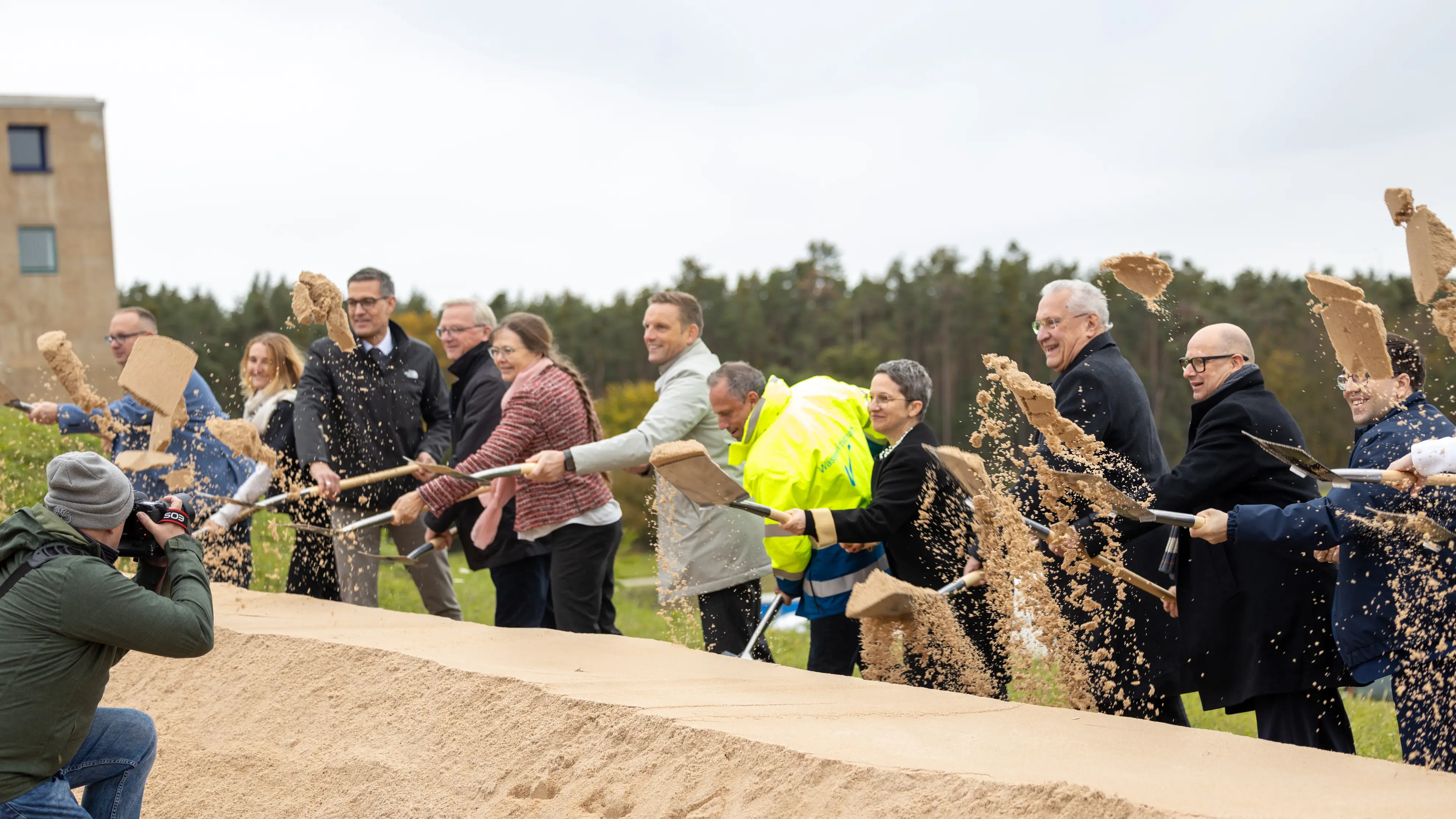
Erlangen, Germany – The symbolic groundbreaking ceremony on October 23 officially marked the start of construction of the new Erlangen lock on the Main-Danube Canal. Federal Minister for Transport Steffen Bilger, representatives of the Aschaffenburg Waterway Construction Office (WNA), acting as the client, and the construction partners attended the ceremony to mark the official launch of the project.
The replacement of the Erlangen lock is an important step towards ensuring the long-term performance and reliability of the Main-Danube Canal. The existing lock was commissioned in the early 1970s. The new lock will modernise the canal’s infrastructure and ensure it remains fit for purpose for decades to come. The project is being delivered by a joint venture (ARGE) comprising ZÜBLIN, a subsidiary of STRABAG, and BAUER Spezialtiefbau GmbH. This is already the joint venture’s second lock replacement project in the region: the team has been working on the replacement of the Kriegenbrunn lock since 2024.
“The construction of the new Erlangen lock is a project of great significance for Germany’s waterway infrastructure. Together with our partner BAUER Spezialtiefbau, we are pleased to be making an important contribution to the modernisation of the Main-Danube Canal. The work will be carried out while navigation continues, placing high demands on planning, logistics and the execution of the works,” says Jörg Rösler, Member of the Executive Board of STRABAG SE.
Mario Theurl, CEO of BAUER Spezialtiefbau GmbH, adds: “Infrastructure projects of this scale require not only technical expertise but, above all, close cooperation and mutual trust among all parties involved. Together with our partner ZÜBLIN, we are contributing our expertise to a project that will sustainably strengthen the long-term performance of the Main-Danube Canal and help secure inland waterway transport in the region for decades to come.”
Focus on Durability and Efficiency
The new lock will be built in concrete, with as few joints as possible, to ensure the long-term durability of the structure. In addition to the new lock chamber, the project includes the inlet structure, the upper lock head, the outlet structure, water-saving basins positioned alongside the lock, and a water diversion structure for water management on the Main-Danube Canal. The new water-saving basins will reduce water consumption by around 60% per lockage.
One of the project’s key challenges is that construction must proceed while navigation continues. This will ensure that the Main-Danube Canal, an important transport corridor, remains operational throughout the construction period.
The replacement lock is scheduled for completion in 2033.
Press Image
Download
Your Contact

